

This morning began with uncertainty. As Israel awoke this sleepy Shabbat morning, I made my way to the command center. As I entered United Hatzalah’s National Dispatch Center I was met with familiar sights and sounds. Walls of the fortified bunker covered with monitors and telephone consuls ringing in unison. And even amongst the symphony of air raid alerts and incoming emergency calls, followed by the calm and reassuring voices of United Hatzalah trained dispatch center operators, I wondered whether I would miss one of the most significant moments of the Jewish calendar; the Torah reading of Parshat Zachor.
Parashat Zachor is not simply another Shabbat Torah portion. The mitzvah to hear the section recalling Amalek, read directly from a Torah scroll, stands apart. It is a commandment rooted in memory and moral clarity. The Torah instructs us to remember what Amalek did to our people in the desert after the exodus from Egypt and to erase their existence from our world. It is a paradox that has shaped Jewish consciousness for centuries. We are commanded to remember, and at the same time to wipe out the evil that sought our destruction.
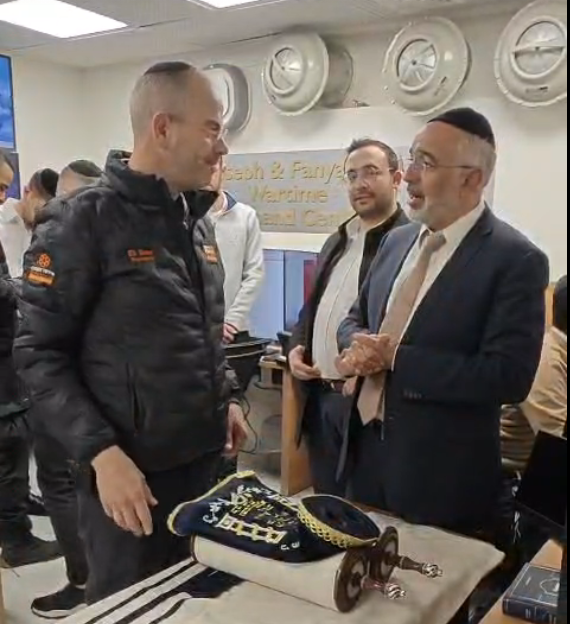
In the controlled intensity of the dispatch room, with phones ringing and updates flowing in real time, Rabbi David Dishi entered carrying a Torah donated by the Hofbauer family. He paused and asked if anyone wished to listen to the Zachor portion.
There was no hesitation.
Jewish and non-Jewish volunteers gathered. Paramedics in orange uniform. Dispatchers at their stations. Medics ready to head out at a moment’s notice. The room fell silent. One of our Arab volunteers quietly filmed the reading so others could witness it later.
It was not a synagogue. There were no pews, no stained glass, no formal bimah. But in that room, surrounded by the instruments of lifesaving work, the ancient words were read with renewed impact and purpose.
The portion that was read aloud across the entire Jewish world would, within hours, take on even more significance. By the end of Shabbat Zachor the news was confirmed, Ali Kahmenei, the Supreme Leader of Iran, a modern-day Haman was eliminated during the airstrikes in Iran carried out by our brave pilots of the Israel Defense Forces. Thanks to the coordination with the United States, Israel’s greatest and closest ally, our greatest and most dangerous enemy was eliminated. It is as if the words of Zachor reached the gates of heaven not only as a historical reminder but a hopeful prayer.
The Torah does not instruct vengeance born of rage. It demands responsibility born of memory. Amalek attacked the weak and the vulnerable. Amalek preyed on those at the margins. The commandment to erase Amalek is a call to confront evil that targets the defenseless. It is a reminder that indifference in the face of declared hatred is the epitome of evil.
For those of us working in emergency response, the connection is stark. We see vulnerability up close. We respond to terror attacks, to accidents, and to sudden medical crises. We do not ask who the patient is before we treat them. We do not calculate background or belief. We arrive; we treat; we save.
In that sense, remembering Amalek is not only about identifying evil. It is about strengthening good. It is about building a society where those who rush toward danger outnumber those who create it.
There was something profoundly moving about watching Jewish and non-Jewish volunteers stand together to hear those ancient verses. The memory of Amalek belongs to the Jewish people, yet the commitment to confront cruelty and defend life transcends faith and nationality. In the dispatch center, that unity was not theoretical. It was lived.
When the final words were read, the verse echoed with clarity: “You shall wipe out the memory of Amalek from under heaven. Do not forget.”
In that moment, memory was not passive. It was active. It was tied to present reality and to future responsibility.
If you were unable to hear Parashat Zachor this year, you can watch the reading from our dispatch center. It may not resemble the setting you are accustomed to. Yet perhaps that is precisely the point.