

Proof that Training Saves Lives
I have been an EMT since 1998. I’ve responded to some of the worst disasters including the World Trade Center attack on 9/11. I spent three and a half days, the hardest days of my life, at ground zero. And yet, after all these years of working in emergency medicine, I’ve learned that training saves lives.
I have seen and experienced things that will forever stay with me as well as others that have faded into the blur of hundreds of routine emergency calls throughout my nearly thirty years of being an EMT.
And yet, every once in a while, a call comes in that reminds you just how important it is to keep training.
Only last week I had completed United Hatzalah’s new adrenaline ampule training course. The training focused on recognizing anaphylaxis, a severe allergic reaction, and the new approach to treating it quickly before it become life threatening. Traditionally we were all used to treating anaphylaxis with an EpiPen auto-injector device. But recently, United Hatzalah announced that it would be transitioning to a new, lesser expensive, treatment protocol using a newly a designed adrenaline ampule injection.
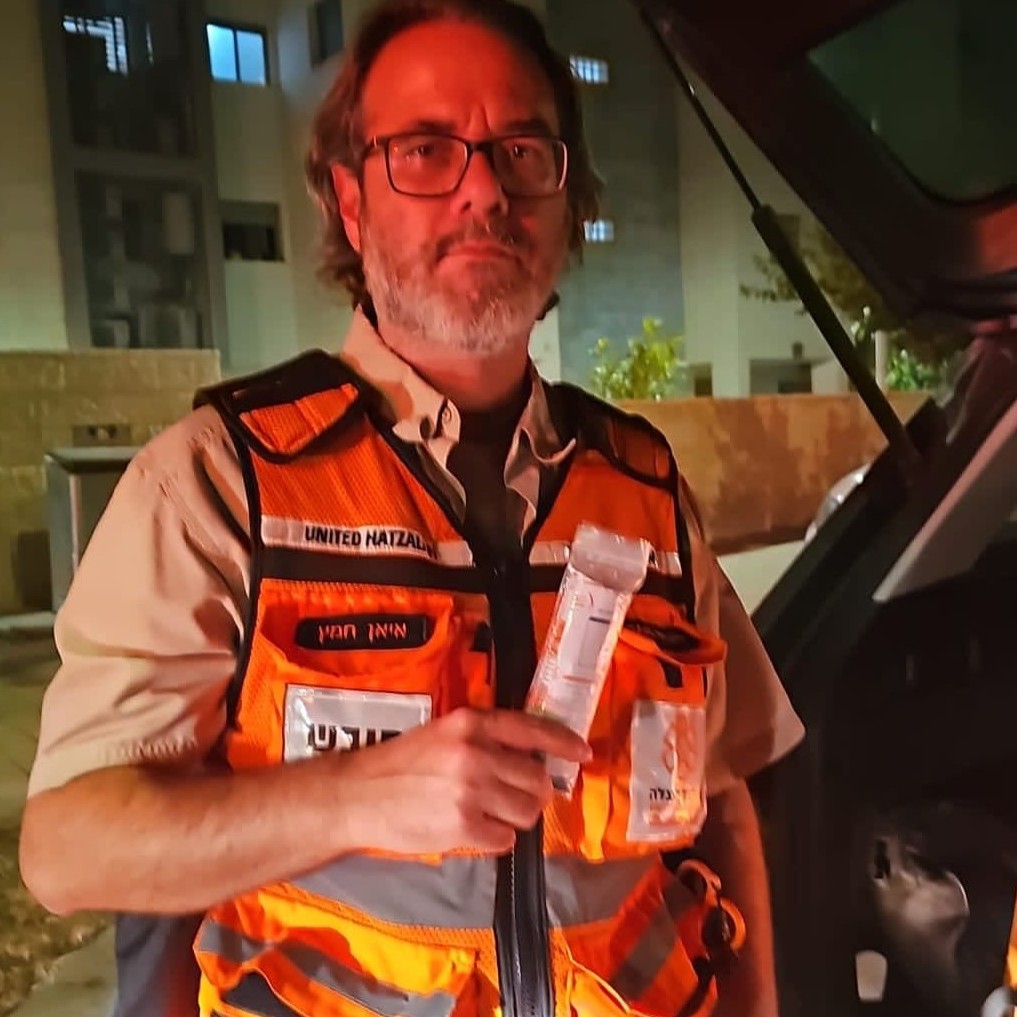
At the end of the course, we received our new adrenaline kits. I tucked it away in my orange medic kit along with all the other lifesaving supplies United Hatzalah provides.
I certainly did not expect to use mine almost immediately.
Little did I know that less than a week later a call would come over my United Hatzalah device and require me to use this newly acquired skill. And then it did. A woman in Harish was suffering from a severe allergic reaction.
Almost instinctively I grabbed my medic bag, that now included the new adrenaline kit, and headed out.
When I arrived, it was immediately clear that this was serious.
The patient was a 42-year-old woman. Her face was swollen. Her feet were swollen. More concerning, her vocal cords were swelling, making it increasingly difficult for her to breathe and speak. She had also developed the rash. All signs pointed to anaphylaxis.
She managed to tell us that she had no known allergies and that she had recently attended a party. She thought that was possibly where she could have been exposed to whatever was making her sick. But she had no idea what caused this reaction.
The truth was, that at that precise moment, identifying the allergen was far less important than stopping the condition from deteriorating further.
Together with two other United Hatzalah medics, we administered adrenaline, provided oxygen and closely monitored her vital signs.
Gradually, she began to stabilize.
Once her condition was under control, she was transferred to an ambulance for further treatment.
Only afterward did everything really sink in. The training I just completed literally helped me save this woman’s life. For me, it felt like divine providence.
I have been involved in emergency medicine for nearly three decades, but experience never means that you stop training and learning. Medicine is always changing. Equipment is constantly improving. And people are always coming up with new protocols. The more you practice the better you will be prepared when the next emergency call comes in and when you’re needed to help save someone’s life.