

Parks and Compressions
There are some calls that, even in the middle of the adrenaline rush, you know will stay with you long after the sirens fade and the scene quiets down.
Today’s call was one of those.
I received the emergency alert on my United Hatzalah device: “Middle aged man collapsed in a public garden on Grossberg Street in Jerusalem’s Givat Moshe neighborhood. Cardiac arrest. No pulse. Not breathing.”
Our training and dedication dictate the response instantly. Drop everything and get there as quickly and safely as possible. Every second before CPR begins can determine the outcome of the call. In our line of work, those seconds often mean the difference between life and death.
As I made my way to the scene, updates came over the radio. A bystander had already started compressions together with another United Hatzalah volunteer. That information matters. Early CPR can dramatically improve a patient’s chances of survival. Still, my determination to reach the scene as quickly as possible did not lessen for a moment.
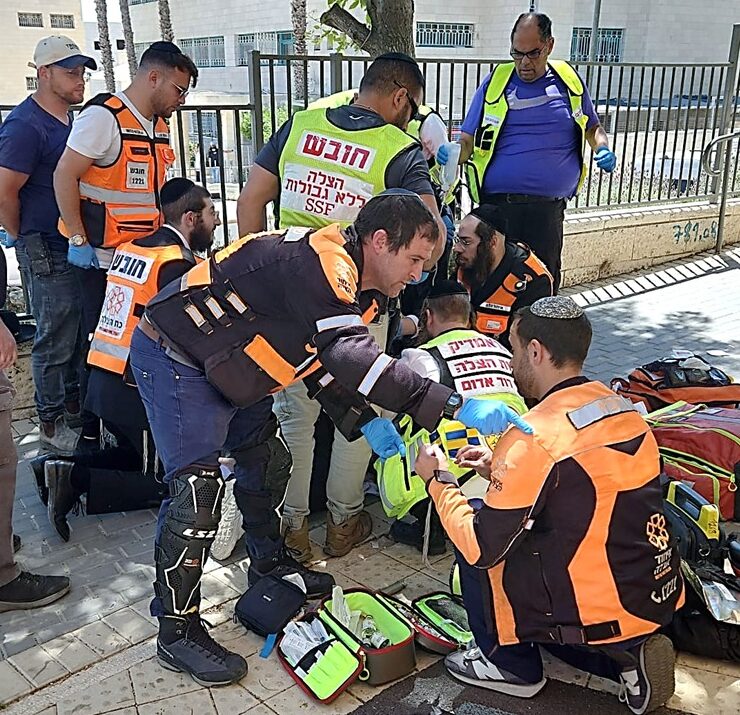
When I arrived at the park, several volunteers were already there. Some had literally jumped over the garden fence to avoid losing precious time. During a cardiac arrest, you do not think about fences, benches, or obstacles. You think about circulation. Oxygenation. Heart rhythm. Survival.
The patient was a 61-year-old man visiting Israel from Switzerland with his wife. They had been walking peacefully through the park with one of their sons when he suddenly collapsed mid stride.
His wife stood nearby in visible shock. I later learned that she herself works in the medical field. She immediately understood what was happening but was physically unable to perform compressions because of a wrist injury. For anyone, but especially for someone who understands the medical reality unfolding in front of them, those moments are unbearable.
All of the responders worked in complete unison.
Chest compressions. Airway management. Defibrillation. Medications. Repeat.
Five shocks were administered.
Alongside the medical response, another kind of care was taking place.
Ryfki Pearlman from United Hatzalah’s Sandberg’s Women’s Unit remained by the patient’s wife throughout the ordeal, speaking with her, calming her, and helping her through the terror of the moment. Daniel Katzenstein, one of our Psychotrauma & Crisis Response responders, stayed with the couple’s son, helping him process the unimaginable scene unfolding before him.
People often think emergency medicine is only about the patient lying on the ground. But very often, the family surrounding the patient needs just as much care and support.
That is part of the beauty of United Hatzalah. We treat emotional trauma with the same urgency and compassion as physical injury.
After prolonged resuscitation efforts, the patient finally began responding to treatment. At one point he even started resisting the lifesaving interventions, which for us was an encouraging sign. After nearly an hour, he was stable enough to be evacuated to Shaare Zedek Medical Center for continued intensive medical treatment. Even during transport, the paramedics continued advanced resuscitation efforts. At the hospital, the medical team immediately connected him to an ECMO machine in the continued fight to save his life.
This is the fragile reality of everyday life.
A simple walk through a neighborhood park can become a fight for survival within seconds.
And sometimes, in those precious moments between life and death, extraordinary people appear from every direction to help save a stranger’s life.