

On that fateful day, the worst day in recent living memory for Jews, United Hatzalah medic volunteer and commander Linor Attias did exactly what she had trained to do, she ran toward the chaos. Most people would run away but not the Heroes in Orange like Linor.
Smoke, gunfire, mass casualties, wounded civilians and soldiers everywhere she turned, the scenes resembled the nightmare scenarios she had previously only thought were possible in Hollywood films and Mass Casualty Incident (MCI) drills. Now, everything was real. The blood. The screams. The danger.
But something else was real too: her training.
“I have a motto in life,” Linor says. “Time is life. And training saves lives.”
The Drill That No One Wants—But Everyone Needs
Linor is one of United Hatzalah’s most senior operational commanders. Over the years she has taken part in some of Israel’s most complex emergency training exercises; terror attacks, wildfires, bus shootings, hostage evacuations under live-fire simulation, and multi-casualty triage in chaotic environments filled with smoke, noise, and confusion.
Some of these drills she didn’t just participate in—she commanded.
“I was the one calling dispatch to request what I needed,” she recalls.
“More stretchers, more volunteers, more ambulances, even a medical helicopter, whatever it took to save lives. And the drill forced me to make those decisions fast, under pressure.”
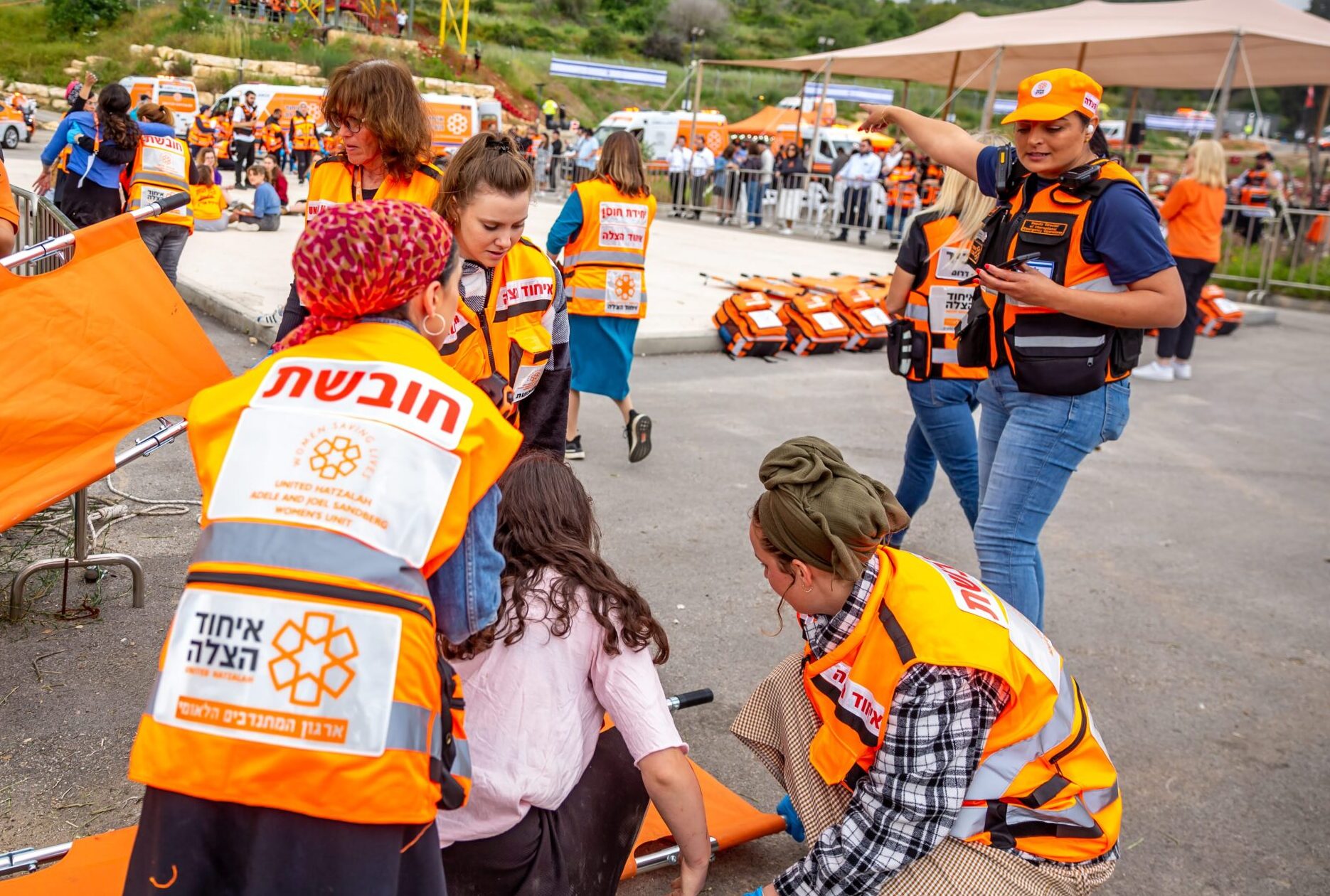
United Hatzalah drills are not theatrical. They are deliberately overwhelming. It takes months of planning to formulate and execute a MCI drill successfully. You need a lot of resources. A makeup artist to create realistic wounds. Pyrotechnic experts to mimic explosions. Smoke machines, lights and sirens to confuse the senses and get that adrenaline running. And most importantly you need actors to scream and simulate the wounded.
“You really feel like you are in the middle of a real live incident,” Linor says. “Your heart reacts. Your body tenses up. Your mind goes into overdrive. But that is exactly the point. All these conditions are what you will face when the worst happens,”
A Drill That I Will Never Forget
One drill that particularly tested Linor’s ability to keep it all under control and do what she needed to do to save lives was a drill where her daughter played the part of a gunshot victim.
“They wanted to see if I could separate emotion from duty,” she says.
“They wanted to know if I could stay professional even when confronted by every parent’s worst nightmare. When someone you love is a victim.”
Her daughter lay on the ground, covered in fake blood, simulating catastrophic neurological trauma. It was a deliberate stress test for a commander tasked with making decisions that determine who lives and who dies.
“I had to shut down emotion. I had to think clinically. And I had to keep commanding the field.”
At the time, she couldn’t have imagined how critical this training would be. But then October 7th came and she quickly found out. As the massacre unfolded across southern Israel, United Hatzalah mobilized. Linor was one of the first operational commanders to respond and arrive on the scene. “The environment was exactly like that drill. Smoke. Screaming. Sirens. Gunfire. Panic everywhere. And even despite all this, duty called!”
Among the first casualties she had to deal with was brought to her in a United Hatzalah ambulance that day. An IDF commander shot in the head by a terrorist.
“Just like the injury my daughter play-acted a few months before unfolded in front of me this time for real. I knew his only chance was to be evacuated by helicopter and taken quickly to hospital for further medical treatment,” she says. “And because of the drills, I knew exactly how to get that done.”
United Hatzalah’s MCI drill trained her in how to address this exact scenario. How to assess whether a helicopter is necessary? What to do to prepare the patient for evacuation? And even how to choose a safe landing zone without hazards from electrical wires and other things?
“I needed to work through all these questions in my head, quickly and under extreme pressure. I immediately recognized the severity of his injury. I knew how to pick the safest landing point for the helicopter. I knew how to prepare the commander for evacuation. And most importantly I knew time was of the essence. Every aspect had been drilled into me thanks to my training.”
“As a result of my training the patient survived and was able to reunite with his family once stabilized.”
“That is the direct connection between training and saving lives,” Linor says. “Its not theoretical. The drill prepared us for October 7. The drill taught me how to act. The drill saved lives.”
Linor has participated in dozens of United Hatzalah MCI drills. Each drill concentrates on different scenarios aimed at teaching different skills. “We never know where the next attack will happen or what it will be, but we know that it is coming,” she says. “That’s why we have to train in multiple scenarios so that everyone knows what their role is.”
Linor’s story is not an exception. It is how United Hatzalah has prepared its network of over 8,000 volunteers and how it responds to some 700,000 calls annually. “We run these drills across the nation so that all our volunteers can experience one. But we need to do more. The reality of life in Israel.”
The United Hatzalah MCI Drill Campaign exists to ensure that every volunteer in Israel has this level of preparation. If you wish to support these lifesaving drills, you can contribute to the program and help us prepare for the emergencies we pray never come but know we must be ready for.
You know Linor’s motto:
“Time is life, and training saves lives.”