

Every Israeli knows the sound. That sudden explosion followed by the gut-wrenching wailing siren of urgency. No matter how long it has been since the last attack, you can’t easily forget it. And more importantly when faced with it, your adrenaline immediately begins to course through your veins, and your body responds in one of three ways. You fight, run or freeze in your tracks.
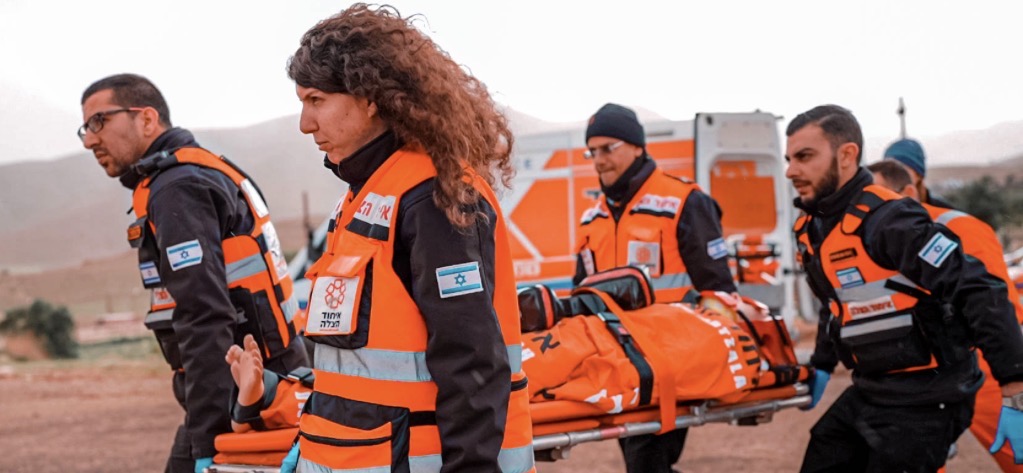
For United Hatzalah’s more than 8,000 first responders, those first seconds after the explosion are the most critical and they need to know how to respond amid all the surrounding chaos. Fear cannot dictate their actions, neither can the instinctive flight response. Experience and professionalism are essential reactions to these emergency situations and dictate life or death outcomes.
That is why United Hatzalah’s Mass Casualty Incident (MCI) training program is not a luxury. It is not an “extra.” It is the difference between freezing… and saving lives.
In the past year alone, with the ongoing regional unrest and natural disasters in our area, United Hatzalah volunteers are often first on the scene of terror attacks involving multiple victims such as stabbings, shootings, car ramming’s, bombings, as well traffic accidents and natural disasters. Their ability to act decisively under pressure comes from one place: training that mirrors reality so closely that when the real moment comes, they do not hesitate.
Few people embody this skill better than medic veteran volunteer and psychotrauma responder Daniel Katzenstein, a man whose actions is indicative of Israel’s national resilience.
“We Don’t Train Until We Get It Right. We Train Until We Cannot Get It Wrong.”
Daniel made Aliyah from Dallas, Texas in 1998. He joined United Hatzalah from the very inception of the organization because he, “wanted to give back to the Land of Israel with all my heart.” He is a long-standing member of the Jerusalem’s Neve Yaakov team. When United Hatzalah started running these mass casualty training exercises Daniel signed up to join and ended up leading several of these drills. “First I attended as an EMT, and then as a psychotrauma responder, and now I participate also as an incident commander,” he reinforces.
He was asked to bring the fake blood for the very first drill which he participated in. “I made the homemade fake blood from chocolate syrup and raspberry concentrate, just like in the movies,” Daniel recalls. “It looked like real blood, and it even tasted good. Unfortunately, it attracted lots of flies, but I guess that made the experience all the more real.”
Beneath the dark humor was a profound lesson: realism matters. The closer the drill resembles the chaos of an actual incident, the more our volunteers are prepared and the more automatic their response becomes when the real thing hits.
United Hatzalah MCI drills use controlled pyrotechnics to simulate explosions and are just as noisy and chaotic as the real thing. Daniel remembers:
“During one of these MCI drills, there was a participant who was an American student who had lived in Israel as a child. Suddenly, she began exhibiting signs of psychological distress, triggered by memories of a terror attack she once experienced. Of course, we paused the drill and as a Psychotrauma First-Responder I began to treat her. It just goes to show you the realistic nature of these drills.”
Two Sons Covered in Fake Blood—Then, a Week Later, the Real Thing
In June 2023, several months before the October 7th massacre, Daniel participated in a full-scale joint MCI drill in Neve Yaakov. The scenario of the drill was a terror attack that took place on the premises of a school. Israel police, local authorities, and dozens of United Hatzalah medics trained for this horrific type of event.
“Just like in other MCI Drills, there were real soldiers, real weapons (secured, of course) and real ‘victims’. Among those playing the wounded were two of my own sons.”
“They screamed like professionals,” he laughed. “Were covered in fake blood, lying on the floor, begging for help. I had to treat them as if they were real casualties. It was intense in a way I cannot even describe.”
Afterward, the team held a follow-up training at the local community center focused on tourniquets, airway management, and wound packing. Skills that are essential for almost any real-life mass casualty incident. “This was hands-on training to create muscle memory.”
Exactly one week later, on a Friday night, just across the street from where the training was held, a terrorist opened fire on innocent Jewish civilians, killing seven and wounding many more. Daniel was on the scene within minutes of the incident.
“This is exactly what we trained for,” Daniel says. “The thing that saved lives that Friday night were the exact skills we practiced one week earlier. We train in the most intense conditions so that when the real deal comes around, we won’t be shocked and we are able to just act.”
2026, United Hatzalah’s Year of Preparedness
We know our amazing volunteers in orange run toward danger. The training provided is to ensure that they know what they are running towards so that they can help save lives. United Hatzalah wants that throughout 2026 all of its 8,000 plus volunteers participate in at least one Mass Casualty Incident Drill that it runs across all of Israel. That’s a lot of drills!
We know that skills alone are not enough. Saving lives requires split second instinct that is honed through relentless practice.
Each and every drill teaches us new lessons, identifies new vulnerabilities, and brings us to develop new strategies.