For ten intensive days, more than forty teenagers from North America sat in a classroom learning how to respond when someone is injured or needs emergency medical services.
There was theory, of course. Videos, demonstrations, mannequins, and plenty of practice on one another. They learned how to assess a patient, check for a pulse, perform CPR, use the Heimlich maneuver, bandage wounds, and apply tourniquets to stop severe bleeding.
They went through the steps over and over.
But what the classroom couldn’t teach, or any instructor or textbook could properly describe, was the pressure and energy of a medical emergency.
It is one thing to know what to do in theory based on what your instructor teaches you to do, especially when they are standing beside you in a calm room guiding you. It is something entirely different when there are sirens, shouting, flashing lights, and more patients than responders.
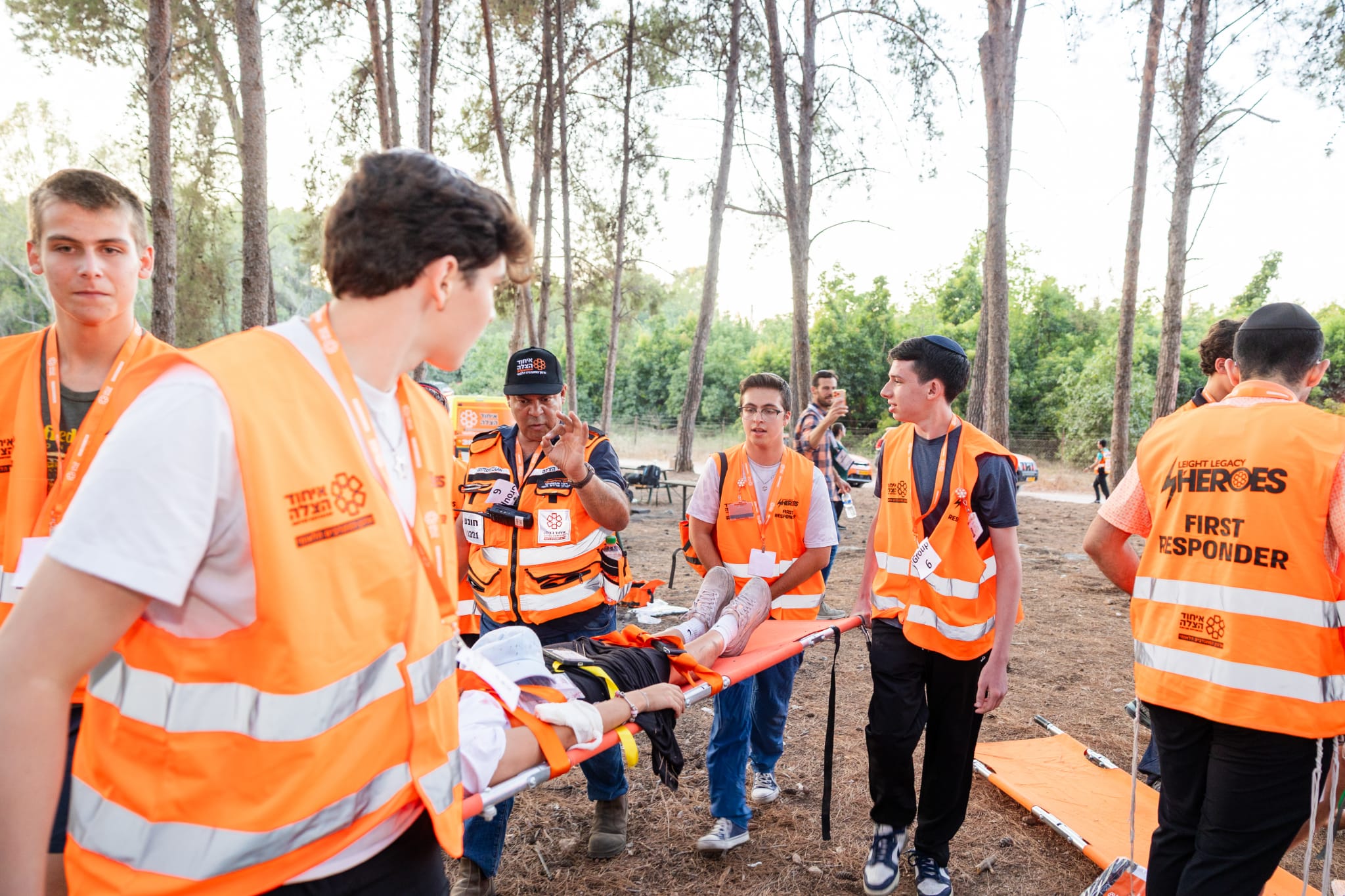
That was the purpose of the mass casualty incident drill held at the Ben Shemen Forest at the conclusion of the ten-day NCSY Hatzalah Rescue training course.
The teenagers arrived to find what looked like, sounded like, and even smelled like a terrorist attack. Simulated gunfire echoed through the trees. There were the sounds of wounded victims crying out for help that you would encounter at the scene of a real attack. Dozens of teenagers with realistic-looking wounds were scattered along one of the outdoor areas. They portrayed patients with bullet wounds, shrapnel injuries, severe bleeding, and emotional shock.
From the moment they arrived, the classroom lessons must have seemed a far-away memory. This scenario is what no lecture can replicate. And the challenge, in all this hectic scene the teenagers were expected to respond.
Wearing medical vests and carrying emergency bags stocked with gauze, bandages, tourniquets, and other supplies, the teens entered the scene alongside a certified United Hatzalah EMT. They moved from patient to patient, assessing their injuries, checking vital signs, triaging, providing the proper treatment, and carrying the wounded on medical stretchers to waiting ambulances.
The exercise was deliberately chaotic. A real-life mass casualty incident does not allow responders the luxury of focusing on one patient at a time. You must learn to make quick decisions of which patients are critically injured and who can wait. You need to determine where the limited medical resources you have at your fingertips are needed most. You must know how to communicate clearly. And the most important thing is to be able to remain aware of what is happening around you at all times. Your safety as well as the safety of the wounded depends on you.
These are drills that experienced United Hatzalah volunteers practice again and again. The goal is not only to learn how to make the right decisions. It is also to recognize what mistakes need to be avoided when the pressure, noise, and confusion take over. In a real emergency, those mistakes can have serious consequences.
“After ten intense days of training, the students had an opportunity to bring everything they learned into the field,” explained United Hatzalah NREMT Coordinator Ari Deutsch. “They were no longer simply discussing emergency medicine in a classroom. They became the providers responsible for triaging and treating patients during an incredibly realistic mass casualty drill.”
This summer marked the tenth year of NCSY Hatzalah Rescue, a program that introduces North American teenagers to emergency medicine in Israel.
Participants begin with an intensive Emergency Medical Responder EMR, course. Once they complete the classroom training, they join United Hatzalah ambulance crews and accompany experienced responders on shifts.
That is where they begin to understand that emergencies rarely look the way they learned in a textbook.
A first responder doesn’t know what they will find when they answer a call for help. The incident may involve chest pain, breathing difficulties, an allergic reaction, a traffic accident, or a patient suffering from serious trauma. Sometimes the situation is immediately clear, while other times, responders must piece together bits of information quickly to determine what is going on. All this, while trying to reassure a frightened patient or family member.
The teenagers learned by watching, listening, and slowly taking part. They also began to understand the responsibility carried by the person who arrives when someone else is having the worst moment of their day.
The participants chose to spend their summer vacation at Hatzalah Rescue for many reasons. Some came because they are interested in medicine. Others were searching for a way to spend the summer in Israel that felt meaningful.
“I am really interested in medicine, and I wanted to spend my summer doing something meaningful,” one participant said. “I am really glad to be a Leight Legacy Hero.”
Yet for whatever reason they came, they all left with a profound scene of accomplishment and self worth.
“I helped someone get into an ambulance, wrapped an injury, applied gauze, checked a pulse, and rode in a ambulance,” one participant recalled. “How many 16-year-olds can say that they did that on their summer vacation?”
Another teenager stated, “It may have been a simulation, but our actions were real.”
The experience also exposed the teenagers to a difficult part of Israeli reality. The scenario was fictional, but terrorist attacks and mass casualty emergencies are not abstract concepts in Israel. United Hatzalah volunteers train for them because they know that preparation can make the difference between hesitation and an immediate, organized response.
“Tonight gave us insight into what a real trauma emergency can demand,” one participant said after the drill. “I was exposed to a scenario involving a terror attack where real lives could be at risk. We all play video games and see these things in the movies but this felt real. I could not have completed this drill without first going through the classroom training and receiving the support of our United Hatzalah instructors.”
NCSY Hatzalah Rescue is supported through the Leight Legacy Heroes initiative, with logistical support from Destination Israel.
The program teaches medical skills, but its impact goes further. It gives teenagers a sense of responsibility and shows them that age does not prevent them from making a difference.
While these teens are not yet experienced EMTs, they got a really unique glimpse of what first responders do. They came to Israel hoping to spend their summer doing something meaningful, and what they discovered was that they are capable of doing much more than they expected.