

For forty days and forty nights, Israel lived between sirens and uncertainty. The familiar rhythm of daily life was repeatedly interrupted. Operation Roaring Lion tested the country’s capacity to endure, adapt, and continue.
Now, as alert levels ease across much of the country, a cautious calm has begun to take hold. There is a collective sigh of relief, a sense that the intensity has, for now, subsided. Yet for United Hatzalah, readiness does not take a break with a ceasefire. Volunteer medics, paramedics, Psychotrauma specialists and physicians remain poised for whatever may come next. Because even when war pauses, emergencies do not.
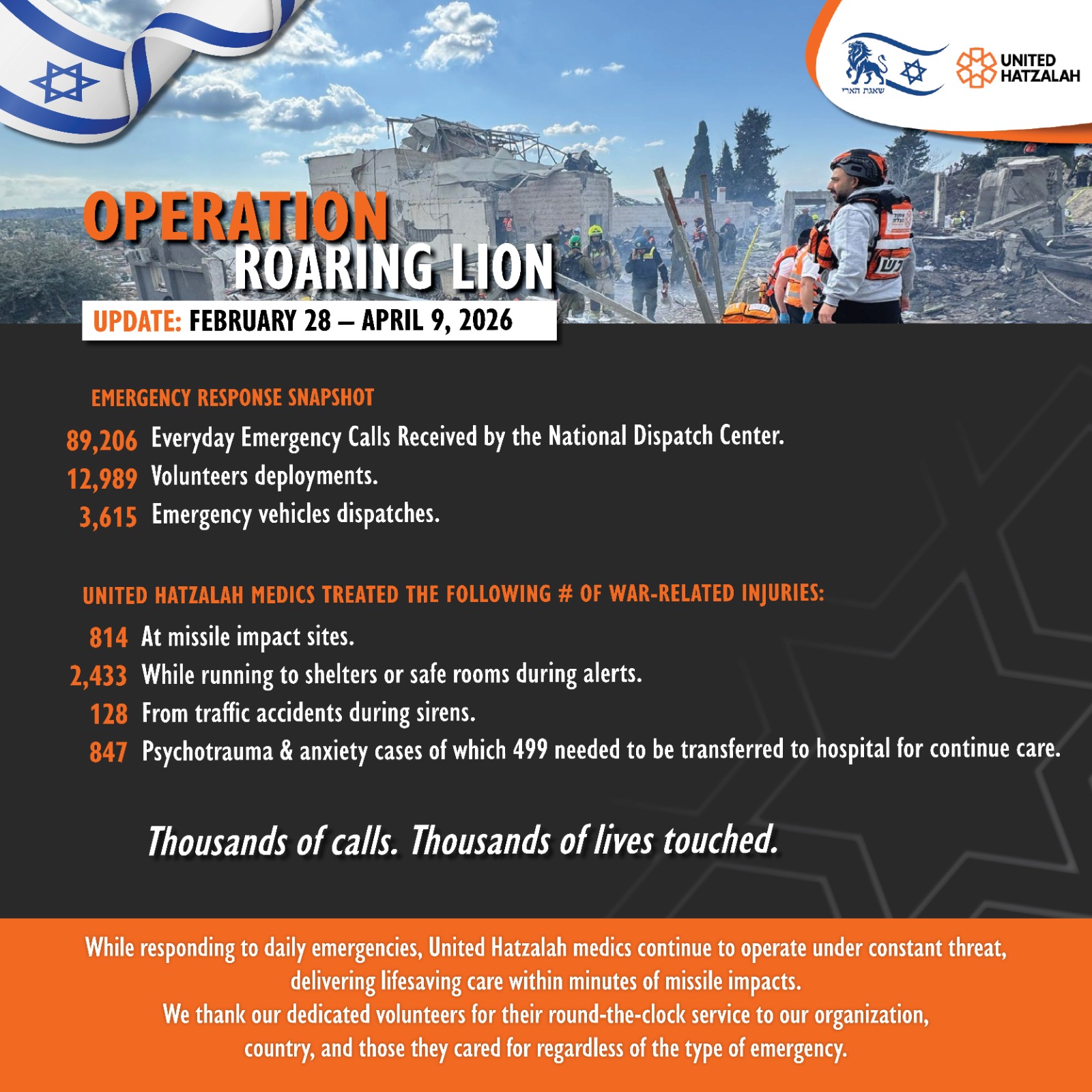
Between February 28 and April 9, United Hatzalah’s National Dispatch Center received 89,206 calls. Some were the direct result of injuries and needs following missiles. Many more reflected the constant reality of everyday medical emergencies. Cardiac arrests. Emergency childbirths, at times unfolding under the threat of incoming sirens. Car accidents. Allergic reactions. Burns. Slips and falls. In each case, volunteers in orange vests arrived within minutes, ready to treat.
Alongside this ongoing reality, teams responded to 814 injuries at missile impact sites, scenes marked by destruction and disorientation. Residential buildings impacted. Neighborhoods shaken by the explosions.
Across the country, millions of Israelis moved repeatedly between homes and shelters, day and night. Those hurried moments carried their own risks. 2,433 people sustained injuries while rushing on foot for cover from the incoming missilesand 128 people were injured in road accidents during or immediately after sirens.
These weeks underscored a simple truth. War does not pause the human condition. If anything, it intensifies it.
There were several moments that captured this reality. In Bnei Brak, medics delivered a baby girl in the courtyard of a residential building as a Red Alert siren sounded. The umbilical cord was wrapped around her neck. Acting with composure under pressure, the team brought new life into the world as the threat lingered overhead.
Earlier on during the war, a volunteer EMT treated a cardiac arrest patient in the middle of a cemetery during also while an air raid siren sounded above. What would normally be a controlled emergency became layered with danger and urgency. Even as they worked to save others, volunteers remained acutely aware of their own vulnerability.
Our efforts didn’t always result in lives being saved. 23 people were killed in the missile barrages, including one of our own Orange Heroes, Ronit Elimelech. Ronit was killed on the second day of Operation Roaring Lion in a direct missile attack in Beit Shemesh. She died alongside her mother, Sarah, and eight other innocent people.
Not all wounds were visible. The psychological toll has been significant. 847 individuals suffering from acute anxiety were evacuated for further care requiring specialized care from our Psychotrauma & Crisis Response Unit volunteers. This critical care provided in the first moments following an attack helps restore a sense of balance to the chaos and often mitigates the onset of more serious psychological injuries.
In total, 12,989 volunteer deployments took place across the country, supported by 3,615 emergency vehicle dispatches. From major cities to remote communities, the presence of United Hatzalah was constant. The mission remained unchanged. To reach those in need within seconds and to preserve life.
And yet, even as parts of the country begin to settle down, the reality is far from uniform. In the north, communities continue to endure ongoing missile fire from Hezbollah. Families dance between living rooms and bomb shelters with little warning. Children still mark time by alerts rather than hours. For them, the tension has not eased. In fact, they remain part of their daily reality.
This is the dual landscape of Israel today. A country tentatively stepping back toward routine in some areas, while others remain firmly on the front lines. Our society as a whole is learning to hold both relief and vigilance at once.
United Hatzalah’s volunteers navigate that same balance. Between standing down and staying alert. Because whether it is a missile strike in the north, a car accident on a quiet road, or a newborn taking its first breath in the most unexpected of places, the responsibility remains the same. To respond. To treat. To save.
Operation Roaring Lion may be entering a new phase, but our forces remain on the front lines ready for the next call.