

On most days, Aviya Yahav stands at the front of a classroom, guiding her students through the logic and structure of mathematics. However, when the emergency call comes through, equations and proofs are put to the side and out comes the orange vest and medical kit.
For the past seven years, Aviya has volunteered as a medic with United Hatzalah, part of a nationwide network of responders who leave whatever they are doing to reach people in need within minutes.
Since the onset of Operation Roaring Lion, the rhythm of daily life in Israel has shifted dramatically. Schools have moved online and classrooms have been replaced with Zoom sessions and digital lessons. Yet on Friday night, as families across the country gathered around their Shabbat tables, Aviya and dozens of other United Hatzalah volunteers found themselves responding in real-time to emergencies after the Red Alert sirens.
“I had an uneasy feeling as we sat down to make Kiddush that a siren might come,” Aviya recalled. “Sure enough, just after we washed our hands for the meal, our phones began sounding the warning.”
Her family quickly moved into the shelter, following the Home Front Command’s safety instructions. As they waited, Aviya could hear reports coming through the United Hatzalah dispatch system about possible impact sites nearby.
“When we received the all clear, I immediately notified the command center that I was available,” she said. “Within seconds they dispatched me to a location just a few minutes from my home.”
A Silent Drive Through Empty Streets
The drive to the scene felt surreal.
“The streets were completely empty,” Aviya recalled. “Everyone was still inside their homes or shelters, hoping the missile would fall somewhere else. It was very quiet.”
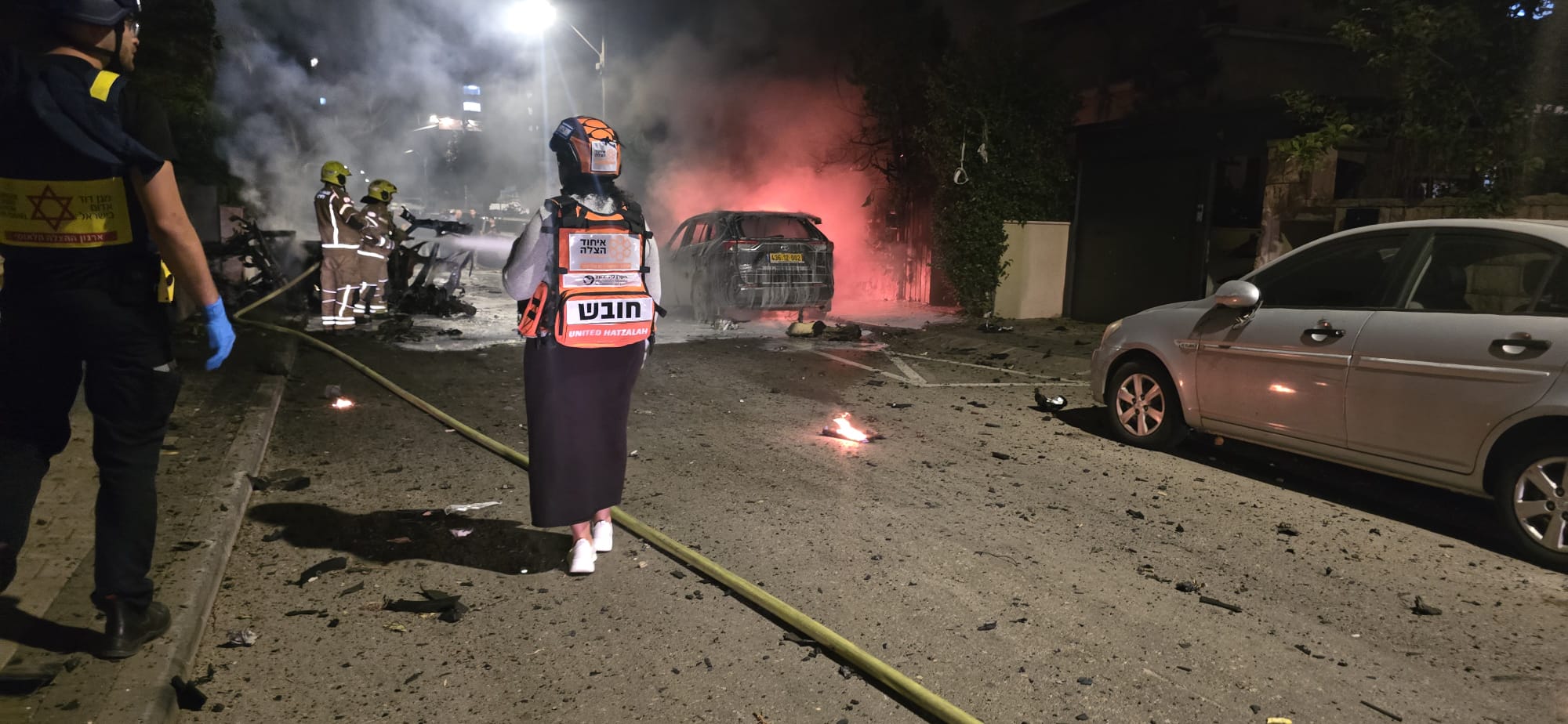
She was among the first EMTs to arrive. Police had already closed off the area and flames from a burning vehicle lit the darkness.
Together with another United Hatzalah volunteer who arrived moments later, Aviya began surveying the scene. At first it appeared that a single vehicle had been hit, but as firefighters worked to contain the blaze it became clear that two cars had been severely damaged.
The role of the medical teams was not to fight the fire. Their task was to find anyone who might have been hurt.
“We began knocking on doors and speaking with residents to make sure everyone was safe,” Aviya said. “Thankfully every person told us the same thing. They had followed the instructions and gone into their shelters.”
That simple decision made all the difference.
Since the beginning of Operation Roaring Lion, adherence to Home Front Command guidance has repeatedly proven to be one of the most effective ways to prevent serious injuries.
“We see again and again that following those instructions saves lives,” Aviya said. “People who enter shelters when the siren sounds are protecting themselves and their families.”
When Two Worlds Meet
Aviya was in full first responder mode when an unexpected moment unfolded. As Aviya continued checking the nearby homes, she suddenly noticed two familiar faces standing among the residents outside.
They were her students.
Because of the war they had not seen their teacher in person for days. Now they were watching her work in the middle of an emergency scene, wearing the bright orange vest of United Hatzalah.
“Their mother looked at me and said, ‘It is so nice to see you, but I never imagined the first time we would meet like this,’” Aviya said with a smile.
Later, as she prepared to leave the scene, the students approached her again.
“They told me, ‘Now we finally understand what you mean when you talk about volunteering.’”
For Aviya, the encounter was meaningful.
“In school they know me as their math teacher,” she said. “But in that moment, they saw another side of who I am and what it means to help people.”
Always on the Ready
The Friday night incident was not the first time an emergency interrupted Aviya’s Shabbat meal. Just one week earlier she had responded to a call involving a young girl who had fainted in a shelter after rushing downstairs during a siren.
“The girl was frightened and disoriented,” Aviya recalled. “Fortunately once I arrived we were able to assess her condition and she recovered quickly. She did not need to be taken to the hospital.”
As with that earlier call, Friday night ended without serious injuries. Yet moments like these highlight the critical importance of having trained responders nearby whenever emergencies occur.
Thousands Like Aviya
Across Israel, United Hatzalah’s network of volunteers includes thousands of people like Aviya. Teachers, engineers, students, parents, shop owners and retirees who set aside their daily routines to help strangers in moments of crisis.
When the call comes, they leave their homes, their meals, and sometimes even the quiet of their Shabbat to respond.
And when the emergency ends, they return quietly to their lives. Until the next call comes.