

Yesterday, a heavy wave of dust and pollution settled over Israel. The Israeli Ministry of Health issued a public advisory urging residents to remain indoors due to unusually high levels of air pollution.
For many families, it meant spending Shabbat inside. For United Hatzalah EMT Adam Altoriyah, a volunteer medic in the Bedouin city of Rahat, it meant responding to an urgent and complex medical call.
The patient was an infant only a few months old, born with significant underlying medical conditions. The baby is connected to an oxygen concentrator and a feeding device. According to his mother, he was suffering from acute respiratory distress, and his skin began turning bluish. After consultation with the treating physician, the instruction was clear. He required immediate evacuation to the nearest emergency department.
While the baby is Adam’s cousin, the response was carried out with the same professional protocol applied to every emergency across Israel, regardless of race, religion, or background.
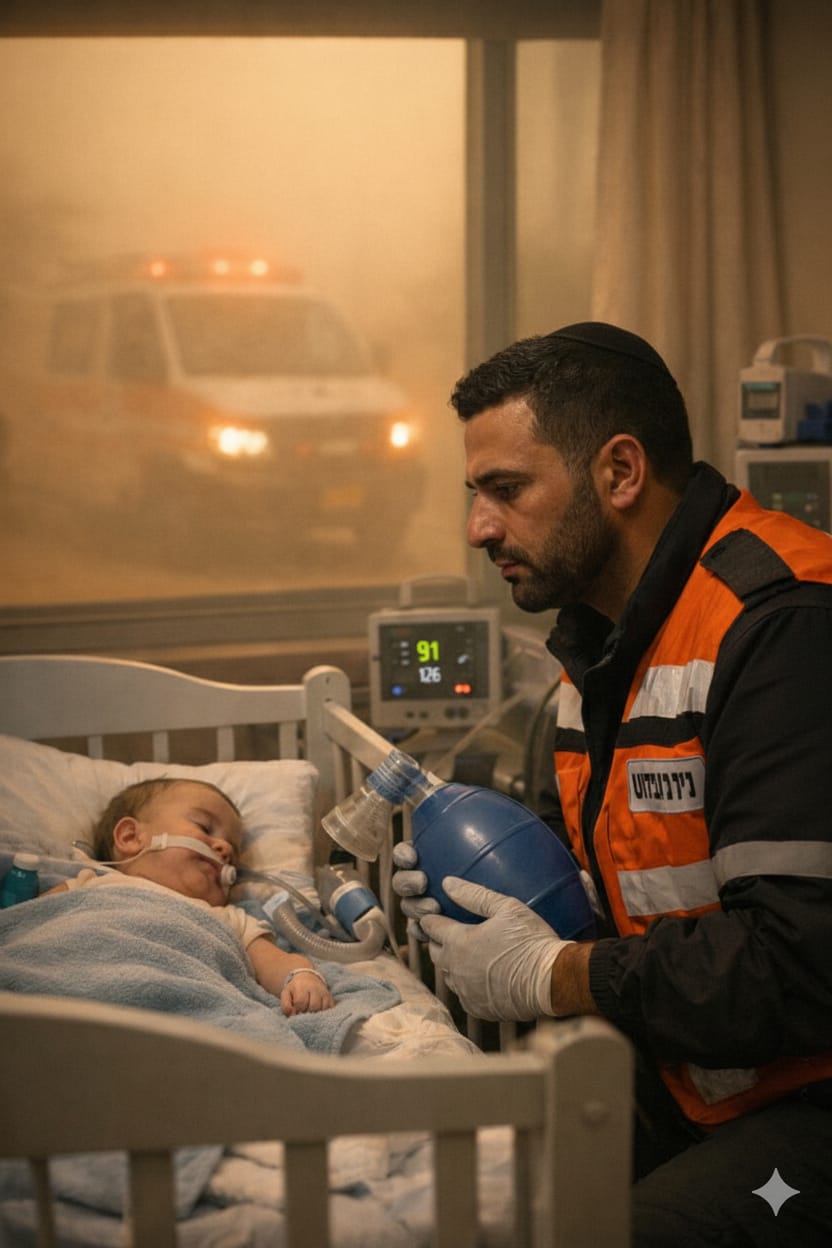
Upon Adam’s arrival he found the infant lying in his crib with visible breathing difficulty. A pulse oximeter reading showed oxygen saturation at 89 percent, despite being connected to a home oxygen concentrator. Wheezing was audible with each breath, indicating significant respiratory compromise.
Following established medical guidelines, Adam increased the oxygen flow on the concentrator to 6.5 liters per minute. The saturation rose modestly to 91 percent, but the child remained in distress. In infants with complex medical conditions, even small fluctuations in oxygen levels can have serious implications. Sustained oxygen deprivation can quickly escalate into a life threatening situation.
At that point, another complication arose. Just the day before the Israeli Ministry of Health issued a directive which temporarily suspended use of certain oxygen cylinders supplied by a specific vendor, pending a technical review. This initiative affected many medical institutions and providers, including United Hatzalah. Adam’s medical kit oxygen canister was among those affected.
This situation underscored a broader but very critical aspect of the reality of emergency first response medicine. Oxygen is not an accessory, it is a primary intervention. For many patients, even ones not in respiratory distress, the administration of oxygen is part of standard care protocols. For an infant, like the one Adam was caring for, it was crucial and could have meant the difference between a patient’s medical stability and recovery or the opposite, deterioration.
Adam immediately requested a mobile intensive care ambulance to the address.
While waiting, he remained at the infant’s bedside, monitoring saturation and respiratory effort, ambu bag ready in case manual ventilation became necessary. The baby’s breathing remained labored. The situation required vigilance and readiness for rapid intervention.
Within minutes, an intensive care ambulance arrived. The advanced life support team conducted a reassessment and connected the infant to their oxygen supply and additional equipment. Treatment continued seamlessly, and the baby was transported to Soroka Medical Center for further evaluation and care.
This incident serves as a reminder of the essential role oxygen plays in prehospital medicine. During periods of extreme air pollution, vulnerable populations, particularly infants, the elderly, and those with chronic respiratory conditions, face increased risk. For emergency responders, ensuring access to approved, functioning oxygen equipment is critical.
United Hatzalah’s volunteers respond to thousands of calls each month across diverse communities throughout Israel. Whether in large cities or smaller towns such as Rahat, the mission remains the same. Provide rapid, professional care with the tools and training necessary to stabilize patients when every breath matters.
While the air over Israel was thick with dust the responsibilities of the Heroes in Orange were crystal clear.