

We go to the Kotel to Pray to G-d for Help. Instead, I Was Called Upon to Help
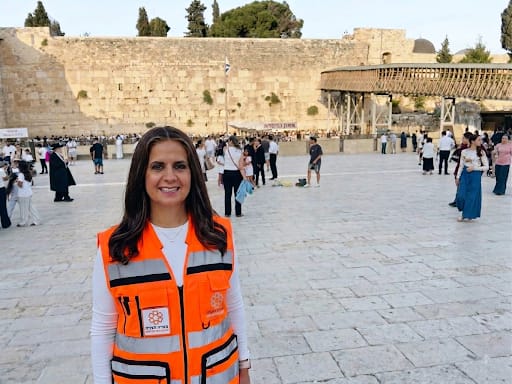
Rosh Chodesh Elul is always a big deal. It is a time filled with so much potential and, at the same time, so much trepidation. The Jewish New Year is rapidly approaching, and many are taking stock of the year that was. That is why it felt natural for me to decide that this morning was the perfect time to go to the Kotel, the Western Wall, where so many Jews come to feel a deeper spiritual connection to G-d.
So, off to the Kotel I went.
As I made my way through the narrow alleyways of the Arab Shuk, continuing my familiar journey toward the place where G-d’s presence feels so palpable, my United Hatzalah emergency communication device suddenly buzzed.
An elderly woman had fallen in the women’s section of the Western Wall plaza and suffered a serious head injury.
That was all I needed to hear. In an instant, my personal prayer visit became an emergency response call.
I sprinted down the remaining stairs of the market, hurried through the security checkpoint, and headed directly toward the women’s prayer section.
When I arrived, I was joined almost immediately by Moti Arush, the head of United Hatzalah’s Ramat Beit Shemesh branch. By complete coincidence, he had also come to the Kotel that morning to pray.
Together, we found the woman who needed our help. The approximately 80-year-old woman was lying on the ground in considerable distress.
She had apparently tripped over a low cement structure used for shade in the plaza and fallen hard. The impact had opened a deep wound on her head, and she was bleeding heavily.
Head wounds can bleed dramatically, particularly among elderly patients, and our immediate concern was controlling the bleeding while making sure there were no signs that her condition was deteriorating.
We checked her vital signs and found that her blood pressure was extremely high. We applied a pressure dressing to her head and began treating her for the trauma of the fall. Another medical team arrived shortly afterward, allowing us to clean the wound more thoroughly, continue monitoring her, and prepare her for transportation to the hospital.
But as we worked, and sounds of the shofar surrounded us, another part of the situation became increasingly important.
She was completely alone.
No daughter was standing nearby. No husband. No friend there to hold her hand.
When we asked who she had come with, she quietly told us that she had been widowed at 67 and came by herself.
“I’m just here with my Creator,” she said.
That sentence got me thinking.
My day had begun with an intense desire to connect with my Creator and to pray during this special time of the Jewish year. Yet even though my lips had not uttered a single word of prayer, I suddenly found myself feeling closer to the Divine than ever before.
I was standing a stone’s throw from the Temple Mount, the holiest site in Judaism, and I had been given the opportunity to help another person at a moment when she desperately needed someone beside her. In my book, few things are more rewarding or more sacred than that.
We spend so much of our lives searching for a spiritual connection. Yet in that moment, I realized that sometimes lending a helping hand can create the most powerful connection of all, a bond with the Master of the Universe, the Creator of all life and the One who gives us life each and every day.
This 80-year-old woman became G-d’s messenger to me that morning. She reminded me that even when we may feel lonely, none of us is truly alone. Sometimes all it takes is for another person to hear the call and answer it.
I am incredibly grateful that, thanks to the training I received from United Hatzalah, I am able to respond when someone needs medical help. But just like prayer, helping others can take many different forms.
Sometimes all you need to do is show up and say, “I am here. I am ready to help.”
I cannot think of a more meaningful way to begin the month of Elul.