

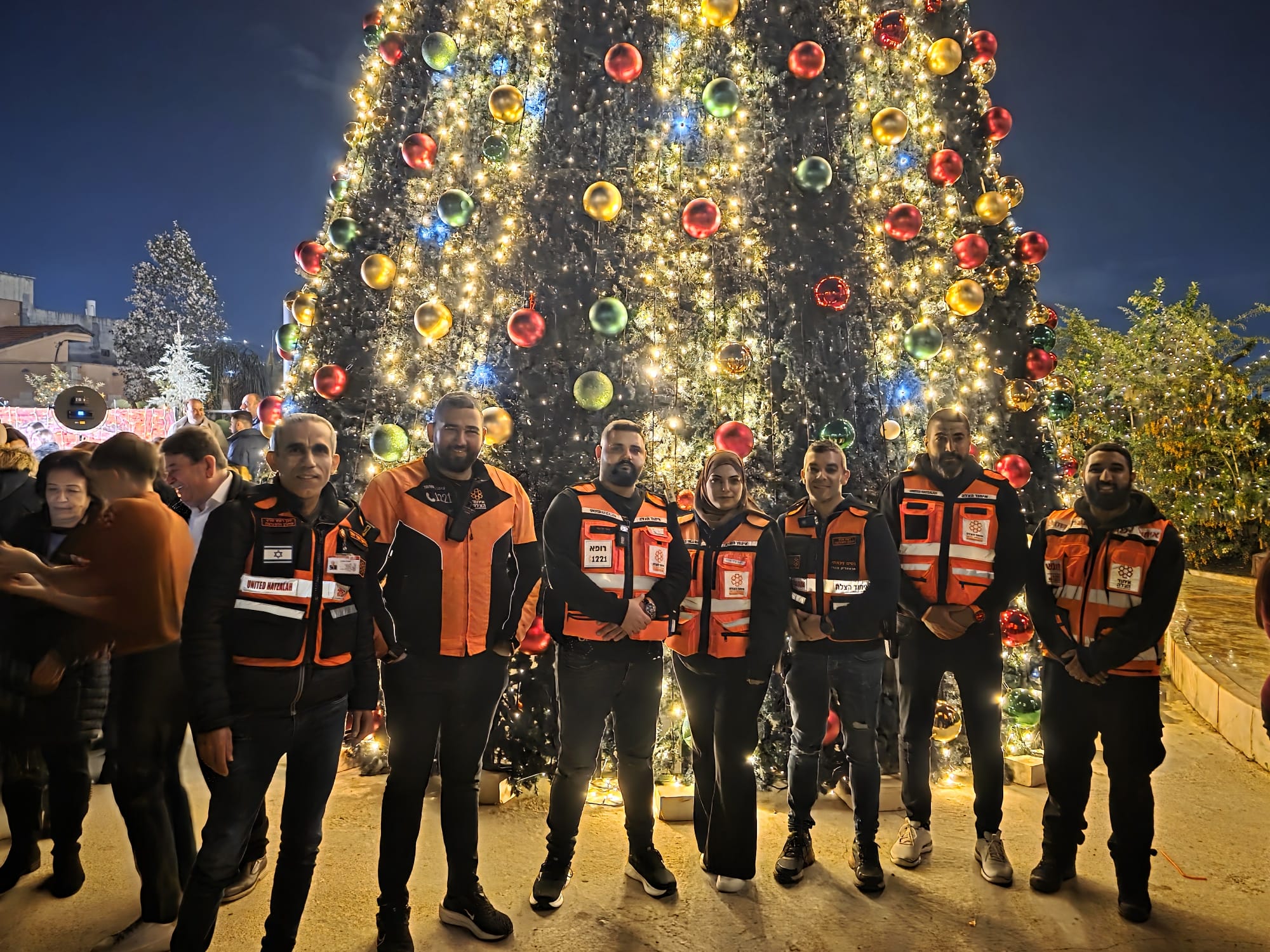
One winter evening in northern Israel, as strings of lights were wrapped carefully around a Christmas tree in a mixed Muslim and Christian town, a really unique and powerful scene unfolded that is counternarrative to the region’s usual headlines. Standing among families, clergy, children and local leaders were Muslim, Christian and Jewish volunteers from United Hatzalah, dressed in their unmistakable orange vests. They attended not as medics responding to crisis but as neighbors taking part in a community building event.
The event was a Christmas tree lighting, organized as a community day aimed at bringing residents together. For the United Hatzalah volunteers who attended, many of them Muslim Arabs serving towns and villages across the country, the evening carried a deeper significance. “It was not about religion,” one volunteer explained, “but about living together. It was about showing up in spaces where diverse community members gather, celebrate, and feel seen.”
United Hatzalah has long prided itself on a simple principle. The organization does not distinguish between religion, race, or background, both in the 8,000 plus dedicated volunteers, as well as the many people they treat. The dedicated volunteers respond to emergencies wherever they occur and whoever needs help and they provide this emergency medical treatment free of charge. In recent years, that ethos has expanded beyond emergency response into deliberate community engagement, particularly in Arab communities where awareness of the organization has not always kept pace with its reach.
Community days, like the one held alongside the Christmas celebration, are designed to close that gap. Volunteers introduce residents to United Hatzalah’s work and equipment as well as the dispatch center number 1221. They explained how the organization operates and clarify that United Hatzalah is a network of trained volunteers, including doctors, nurses, and EMTs, dispersed throughout cities and villages and able to arrive within minutes.
“For many people, this is the first time they really understand who we are and what we do,” another volunteer said. “They may have seen our emergency vehicles zoom by or the volunteers donning orange vests, but they did not really know that we are from their communities.”
The impact, volunteers note, is tangible. Once people understand how the system works, they are more likely to call for help when emergencies arise. Familiarity builds trust. Trust saves lives.
What made the Christmas tree lighting especially resonant was the symbolism. Muslim & Jewish volunteers attending a Christian holiday celebration in a mixed community was not framed as a gesture of tolerance, but as something far more impactful.
The conversations that evening reflected this spirit. Parents asked questions about first response. Teenagers lingered near the volunteers, curious about training and volunteerism. Local residents snapped photos of the tree, the lights, and the volunteers standing beneath them, a visual reminder that coexistence in Israel is often lived quietly, far from political slogans.
For United Hatzalah, the evening was not an endpoint but part of a broader strategy. Exposure leads to understanding. Understanding leads to connection. Connection leads to action.